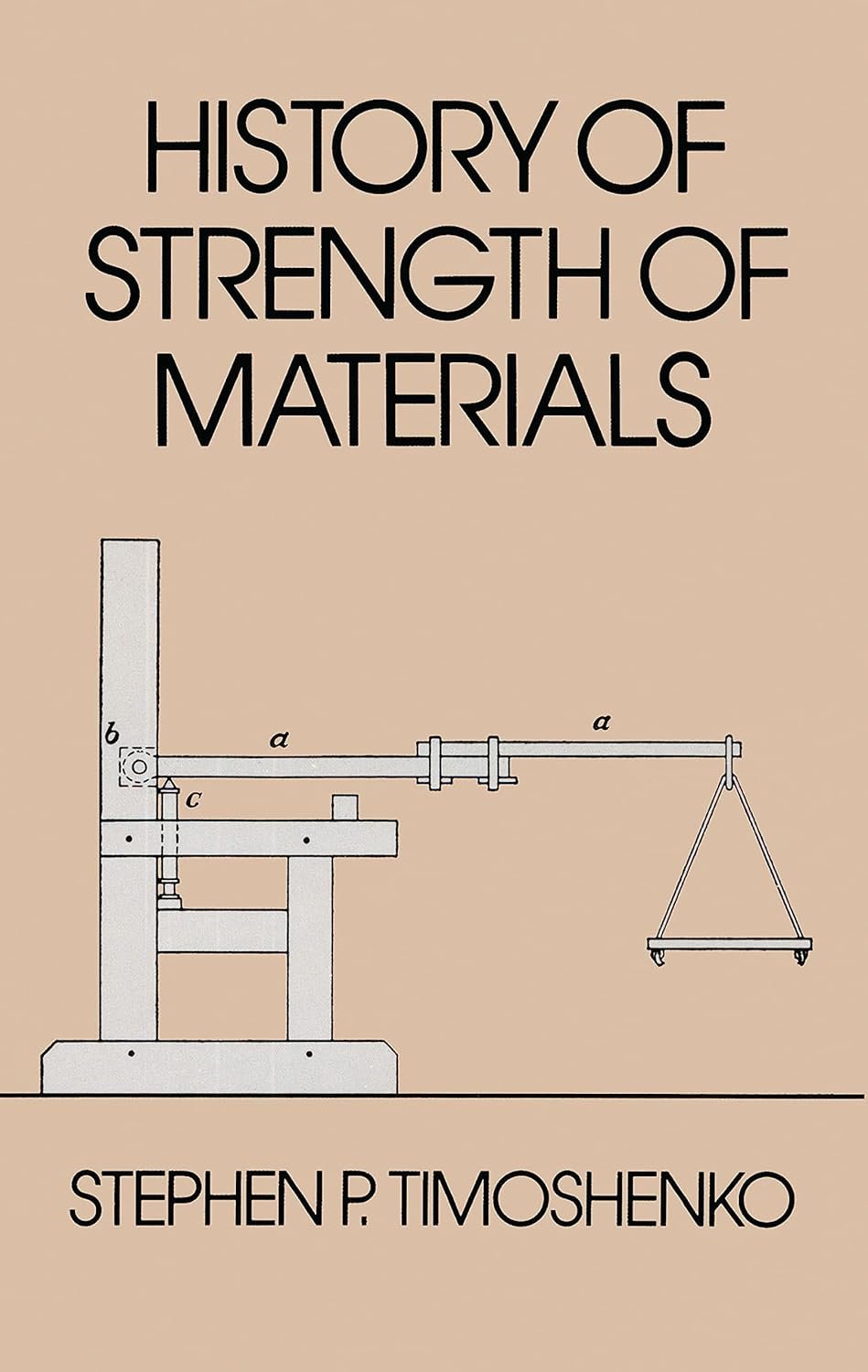
Imagine standing before the great pyramids of Egypt, marveling at how stones stacked millennia ago still defy gravity. That's where Stephen Timoshenko begins his captivating journey through the history of strength of materials, a cornerstone of civil and mechanical engineering.
Strength of materials explores how solids deform or fail under forces beyond simple equilibrium. Timoshenko, drawing from his Stanford lectures, starts with ancient feats—Egyptian pyramids, Greek temples, Roman roads—and pins the modern science's birth to Galileo's 1638 Two New Sciences. From there, he charts the discipline's growth through the centuries, blending theory with real-world applications in bridges, buildings, and machines.
This Dover reprint isn't dry academia; it's alive with stories of pioneers. Euler tackled beam bending, Lagrange refined variational methods, Thomas Young coined 'stress' and 'strain,' while Navier and Saint-Venant laid groundwork for elasticity. Timoshenko weaves in brief bios, clear equation derivations—like the beam deflection formulas—and insights into engineering education across Italy, France, Germany, and England. With 245 figures, concepts snap into focus, making complex math approachable.
Today's skyscrapers and aircraft rely on these principles, yet their origins are often forgotten. This book bridges that gap, helping you select materials for load-bearing components or understand why structures succeed or fail. It's packed with historical context that enriches technical knowledge, answering questions like: How did Kelvin and Rayleigh advance vibration theory? What role did Prandtl play in aerodynamics?
Grab it for your next project—whether designing a truss in school, analyzing historical failures on the job, or just geeking out over engineering heritage. Keep it on your desk as a reference; its Dover affordability makes it accessible. Civil engineering students find it invaluable for exams, pros appreciate the depth, and history buffs love the narratives. Dive in, and you'll see everyday structures with new eyes, appreciating the genius behind their stability.
At around 400 pages of lucid prose and illustrations, Timoshenko's work remains a timeless resource in strength of materials history and Dover's engineering classics lineup.