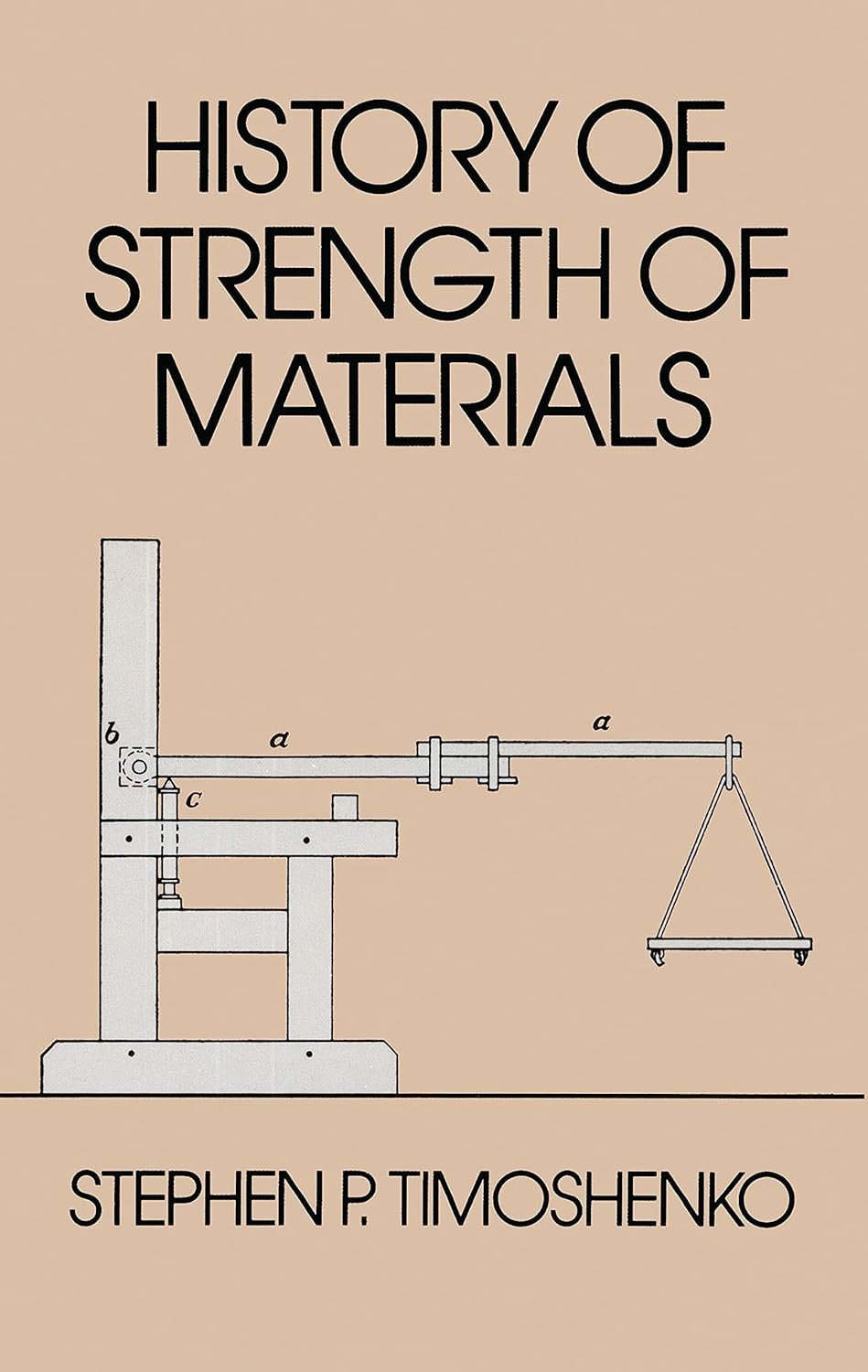
Imagine standing before the pyramids of Giza, marveling at how stones stacked millennia ago still defy time and gravity. That's the kind of awe Stephen Timoshenko evokes in his 'History of Strength of Materials,' a captivating journey through the science that makes structures stand strong. As a cornerstone of civil and mechanical engineering, this Dover reprint draws from Timoshenko's renowned Stanford lectures, offering a narrative that's as engaging as it is educational.
Engineers today rely on precise calculations to ensure bridges don't buckle or buildings withstand earthquakes, but these tools didn't appear overnight. Before the advent of computers and advanced simulations, pioneers grappled with fundamental questions: How much force can a beam take before it bends or breaks? What materials best resist deformation under load? This book addresses those timeless puzzles, showing how early thinkers like Galileo laid the groundwork in his 1638 'Two New Sciences,' sparking a revolution in how we design safe, enduring structures.
Timoshenko doesn't just list dates and discoveries; he brings them to life with concise biographies of giants in the field. Meet Leonhard Euler, whose beam theory revolutionized flexible structures, or Thomas Young, who coined the term 'stress' and delved into elasticity. The text weaves in lucid derivations of essential equations, like Navier's for beam deflection, supported by 245 illustrative figures that clarify without overwhelming. You'll see how these ideas spread across Europe—from Italy's architectural renaissance to Germany's rigorous engineering schools—and influenced global infrastructure, from Roman aqueducts to 20th-century skyscrapers.
Grasping the historical context sharpens your intuition for today's challenges, whether you're a student tackling statics homework or a professional optimizing material choices for sustainable builds. It highlights how elasticity theories evolved to predict failures, helping you avoid pitfalls in projects big and small. Picture using these insights to refine a bridge design or explain to a client why certain alloys outperform others under pressure—the knowledge here bridges theory and practice seamlessly.
Keep this volume on your desk for quick references during lectures, research, or even casual reading on a commute. It's not a dense textbook but a storyteller's take on science, perfect for expanding your library with something that feels both scholarly and approachable. With its focus on real-world applications, from ancient fortifications to industrial machinery, you'll find inspiration in every chapter, reminding you that great engineering starts with understanding what came before.
At around 400 pages, it's a worthwhile investment for anyone passionate about the forces shaping our built environment.