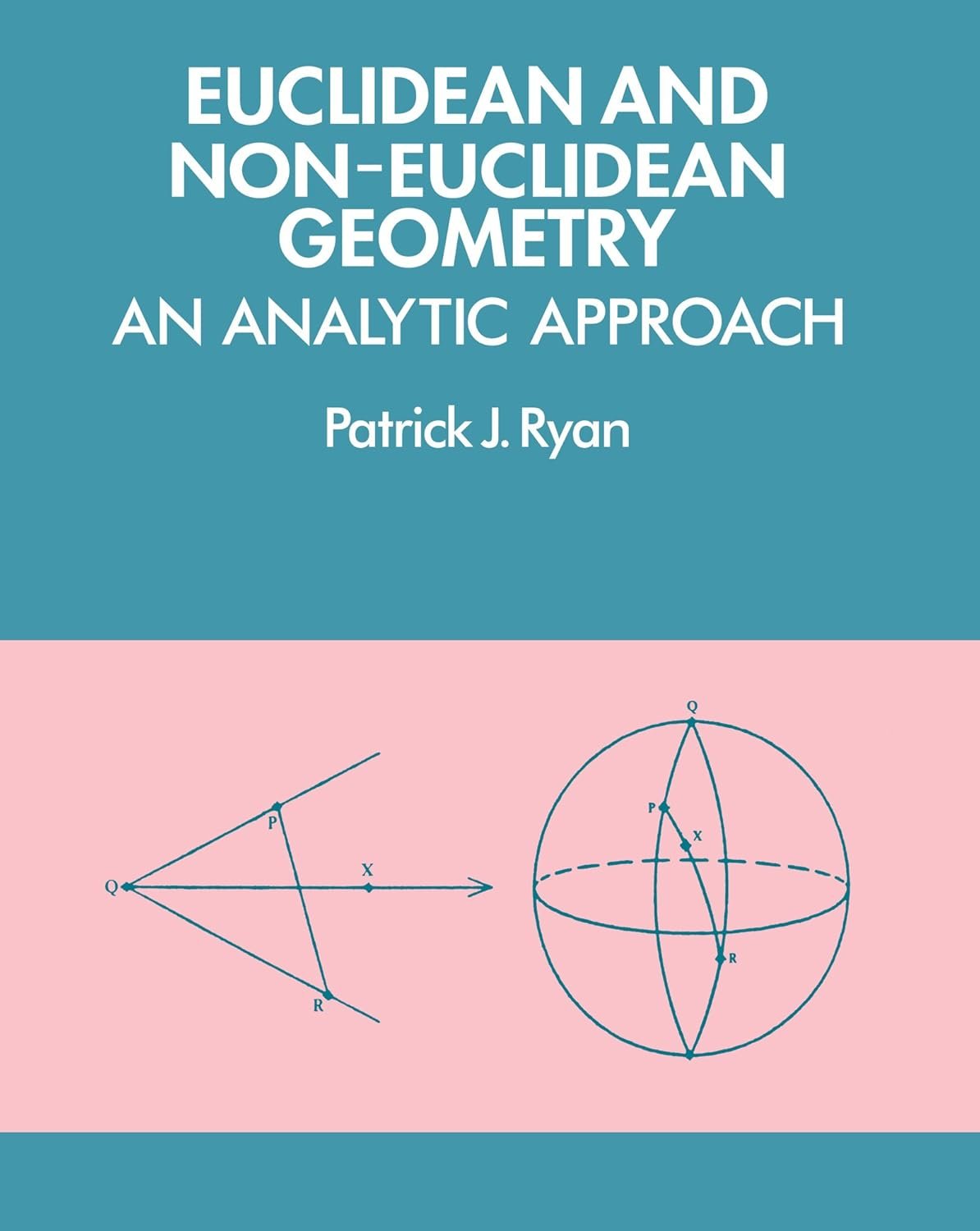
Geometry isn't just about shapes and angles—it's about understanding the fundamental structure of space itself. Whether you're exploring the familiar Euclidean plane or diving into the fascinating world of non-Euclidean geometries, this book provides the analytical tools and theoretical foundation you need to truly grasp these mathematical concepts.
In mathematics today, understanding how different geometrical systems relate to each other is crucial. This book takes you on a journey through the classical geometries—Euclidean, spherical, elliptical, and hyperbolic—showing not just how they differ, but how they connect. You'll explore congruence theorems, concurrence theorems, and classification of isometries while building an arsenal of computational techniques for real geometrical investigations.
The book starts with rigorous fundamentals, ensuring you understand the classical results that form the backbone of modern geometry. You'll work through angle addition formulas, trigonometrical relationships, and the essential theorems that make geometrical reasoning possible. What sets this approach apart is its analytical focus—rather than just memorizing results, you'll learn how to derive and apply them yourself.
As you progress, you'll discover how these classical geometries link to modern mathematical fields. The computational techniques you develop here serve as preparation for advanced study in group theory, Lie groups, differential geometry, topology, and even mathematical physics. The appendices provide all necessary background material, making this accessible even if you need to refresh your linear algebra and mathematical function knowledge.
This book assumes you can already formulate precise mathematical propositions and construct rigorous arguments. It's designed for undergraduate mathematics students who are ready to move beyond introductory material and develop the deep understanding needed for research-level mathematics. Whether you're planning to specialize in pure mathematics or applying these concepts to physics and engineering, this text provides the analytical foundation you'll need.