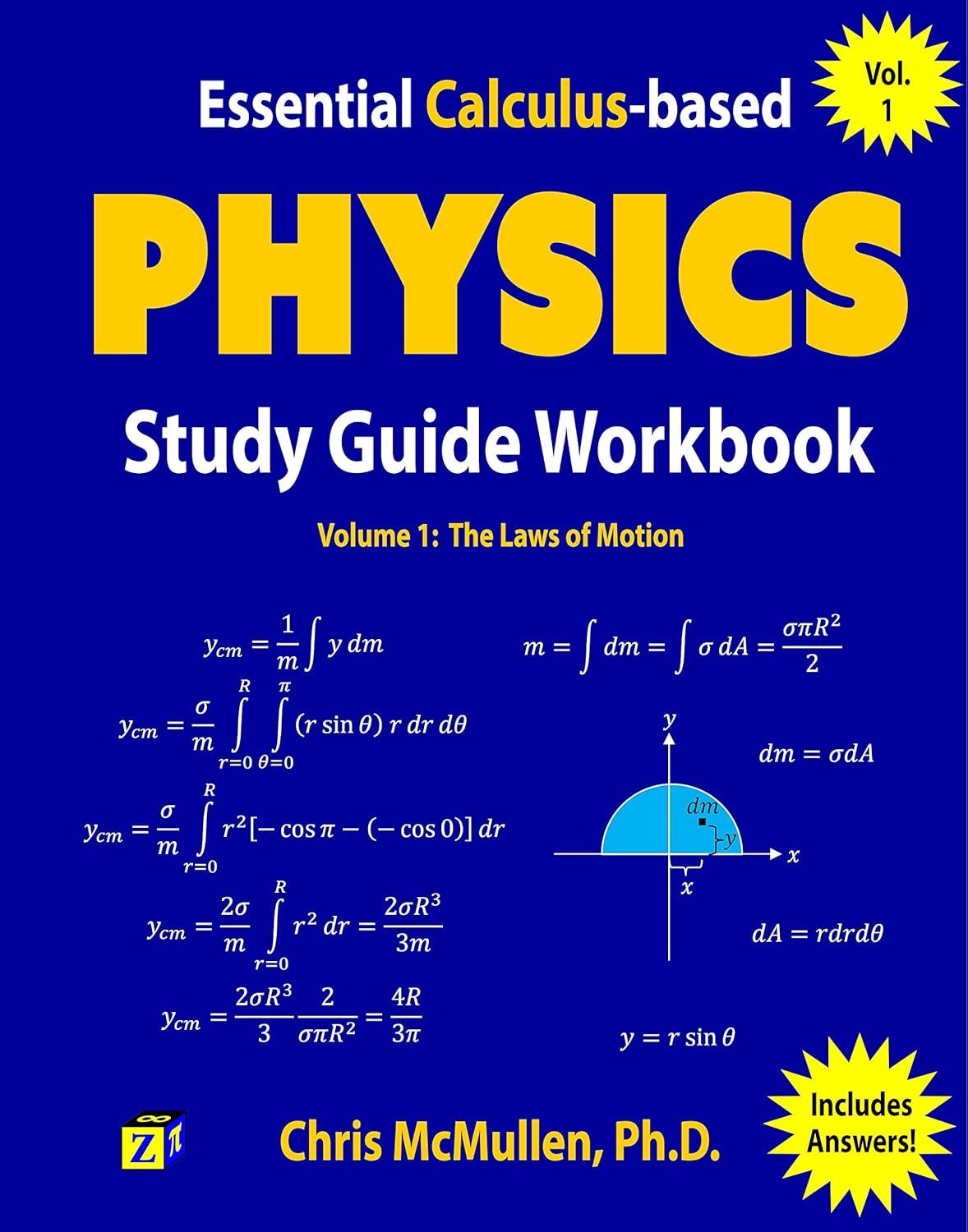
Ever stared at a physics problem involving derivatives or integrals and felt lost? You're not alone—many students hit that wall when transitioning to calculus-based physics. This workbook changes that by guiding you through the fundamentals of motion with clear, practical steps.
University physics demands more than memorizing formulas; it requires understanding how calculus weaves into real-world motion, from accelerating objects to orbiting satellites. Without solid strategies, even basic problems like vector addition or conservation of energy can overwhelm. This guide addresses that head-on, starting from essential math reviews in algebra, trig, and calculus to ensure you're equipped.
Dr. Chris McMullen, with over 20 years teaching physics across universities, distills his expertise into this workbook. You'll find fully solved examples that mirror standard exam questions, showing every calculation—from uniform acceleration to moment of inertia integrals. Handy charts list symbols, meanings, and SI units, while problem-solving strategies are illustrated with real examples. Practice exercises come with hints, intermediate steps, and full explanations, turning abstract ideas into tangible skills. Plus, no calculator needed—hone your estimation abilities for exams like the GRE Physics.
Imagine solving projectile motion problems effortlessly or grasping collisions through energy conservation. This book builds fluency by explaining key terms and concepts, like the scalar and vector products, in context. It's not just about passing tests; it's about gaining intuition for how physics governs everyday phenomena, from car crashes to planetary orbits.
Use it for self-study before lectures, as a review tool for AP Physics, or to prep for standardized tests. Work through chapters on rotation and center of mass during commutes or late-night sessions. Students often say it feels like having a patient tutor who anticipates your questions. By the end, you'll approach physics problems with ease, ready for electricity, waves, and beyond in future volumes.
Dive in and transform your grasp of motion—physics starts making sense when you see the steps unfold.