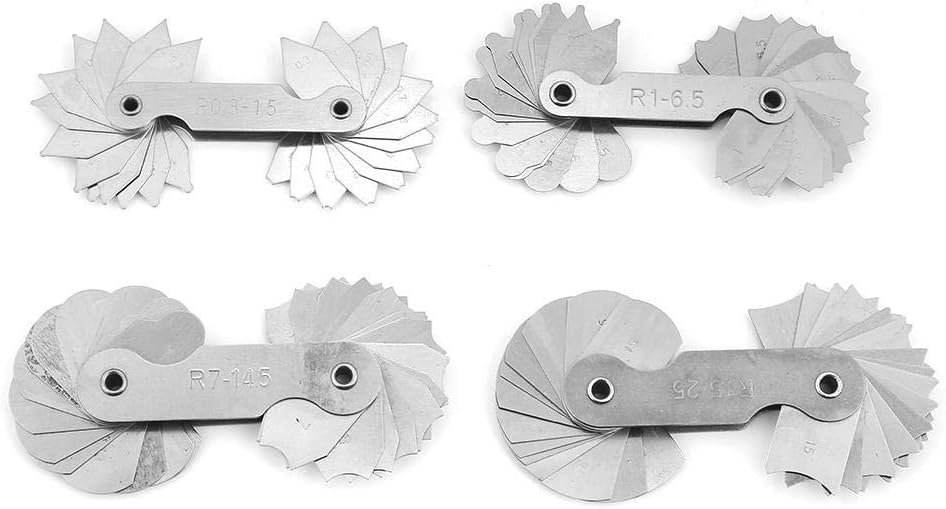
There's nothing worse than spending hours on a piece only to realize the radius is off by a fraction of an inch. That's where a good set of radius gauges becomes worth its weight in gold. This 4-piece stainless steel set gives you the measuring accuracy you need without the guesswork.
These aren't flimsy gauges that bend if you look at them wrong. Made from hardened stainless steel, they're designed to hold up to daily use in real working environments. Drop them, toss them in your toolbox, wipe them down with solvent—they'll keep their shape and accuracy. The steel also resists corrosion, so you don't have to baby them when you're working around coolant or moisture.
Here's what makes this set genuinely useful: each gauge has two types of leaves. One side checks convex surfaces (curves that bulge outward), and the other handles concave surfaces (curves that dip inward). That means you're covered whether you're measuring the outside radius of a turned part or the inside curve of a machined slot. You won't need separate tools or awkward workarounds.
Every leaf is stamped with its size right on the metal. No painted-on numbers that wear off after a month, no tiny labels you need a magnifying glass to read. When you need a 3mm radius, you can spot it instantly and get back to work. The four gauges cover different shape and size ranges, so you'll have options for most common radius measurements you'll encounter.
Tool and die makers rely on radius gauges to verify that molds and dies match specifications. Machinists use them to check corners and transitions on CNC parts. Welders reference them when preparing joints that need specific fillet radii. Quality control inspectors keep them handy for spot-checking incoming parts. Even hobbyist metalworkers and model makers find them indispensable when precision matters.
If you work with metal, plastic, or wood and need to verify curves accurately, these gauges belong in your toolkit. They're simple, durable, and they do exactly what they're supposed to do—tell you whether a radius matches the spec or needs adjustment. No batteries, no calibration, no fuss. Just reliable measurements every time you reach for them.